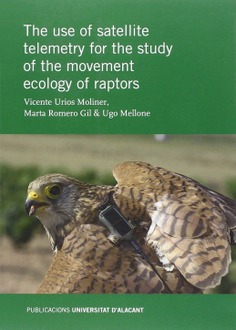
The use of satellite telemetry for the study of the movement ecology of raptors
Vicente Urios Moliner, Marta Romero Gil, Ugo Franco Maria Mellone
Los autores plasman en este libro su experiencia de más de diez años en el seguimiento de rapaces por satélite, para ofrecer al lector desde como capturar las rapaces y equiparlas con un emisor satelital, hasta detallar los diversos objetivos que se pueden conseguir mediante esta técnica.
Mediante ejemplos se especifica como realizar estudios sobre comportamiento, selección de hábitat, dispersión juvenil, rutas, efectos de las condiciones atmosféricas y fenología de la migración, aplicaciones en estudios de impacto ambiental y conservación.
Este libro está ilustrado con profusión de mapas, fotos y tablas.
- Escritor
- Vicente Urios Moliner
- Escritor
- Marta Romero Gil
- Escritor
- Ugo Franco Maria Mellone
- Col·lecció
- Monografías
- Matèria
- Ecología aplicada
- Idioma
- English
- Editorial
- Publicaciones de la Universidad de Alicante
- EAN
- 9788497173810
- ISBN
- 978-84-9717-381-0
- Ample
- 17 cm
- Alt
- 24 cm
- Edició
- 1
- Data de publicació
- 02-10-2015
- Contacto de seguridad
- Universidad de Alicante
Continguts
1. A BRIEF HISTORY OF THE STUDY OF BIRDS MOVEMENTS.
2. SATELLITE TELEMETRY.
3. HOW DOES SATELLITE TELEMETRY WORK?
Running a satellite transmitter.
4. ATTACHING A SATELLITE TRANSMITTER.
Capturing the bird.
Placing the transmitter.
5. ANALYSING SATELLITE TELEMETRY DATA FOR RAPTOR RESEARCH.
Duty cycle of the transmitters.
Data managing and selection.
Spatial ecology: ranging behaviour.
Spatial ecology: dispersal.
Spatial ecology: habitat analyses.
Migration: identification and description of routes.
Migration: speed and time budget.
Migration: effects of weather conditions.
Environmental impact assessment (EIA).
6. STUDIES ON THE MOVEMENTS OF RAPTORS
JUVENILE DISPERSAL.
Golden eagle.
Bonelli's eagle.
CONSERVATION OF MIGRATORY RAPTORS.
Montagu's harrier.
Short-toed eagle.
Eleonora's falcon.
Egyptian vulture.
Booted eagle.
Lesser kestrel.
MOVEMENTS OF RESIDENT SPECIES.
Griffon vle.
Eagles.
7. OTHER STUDIES ON RAPTOR MOVEMENTS.
Harpy eagle (Harpia harpyja).
Crowned Eagle (Harpyhaliaetus coronatus).
Bearded vulture (Gypaetus barbatus barbatus).
8. REFERENCES.